
The care team behind every result
Every result is read by a licensed clinician. Here is what happens between the lab finishing and you finding out.
There is a version of preventive health that is just a data feed. Blood goes in, numbers come out, and you are left to work out what any of it means.
That is not what we are building, and the difference lives in a part of the platform you never see. Between the lab finishing your sample and your results appearing, a licensed Nurse Practitioner reads them. Over the past two months we rebuilt the system around that review. Here is how it works now.
Your results go to a clinician licensed where you live
When the lab finishes processing, your results route to Nurse Practitioners licensed in your province. Not a general pool, not whoever is available. Provincial licensing is not a technicality in Canadian healthcare, and the system now enforces it rather than relying on someone to remember.
Eligible clinicians are notified the moment a new order arrives. Urgent values reach our clinical lead immediately rather than waiting in a queue. Routine orders batch into a daily digest so nobody is interrupted forty times a day for work that is not time-critical.
Nothing sits waiting unnoticed
The failure mode that worries us most is not a wrong reading. It is a result that quietly sits in a queue while everyone assumes someone else has it.
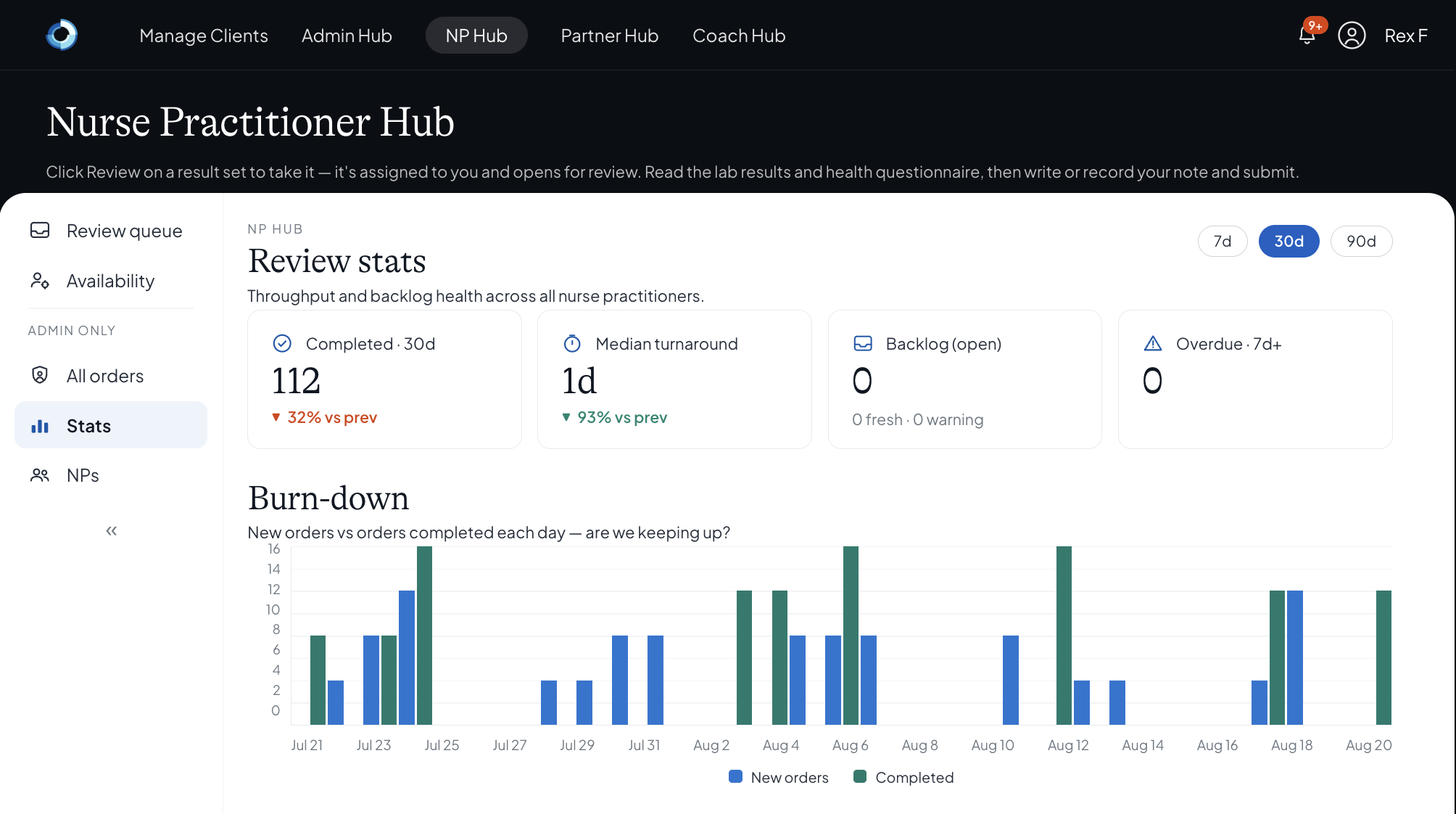
Every order in the review queue now carries an ageing marker at three days and seven days, and a separate daily digest flags anything aging past three, seven, or fourteen days. A backlog cannot build silently, because the system reports on itself every morning whether or not anyone thinks to look.
Completed orders flow into a shared pool that any licensed clinician can claim, so a single person's holiday does not become your delay.
When something needs follow-up, the reason travels with it
If a clinician sees something worth acting on, they raise a flag at one of three severity levels and attach a written note describing what they saw. The most urgent flags surface as a red alert on your coach's client list.
That handoff used to be the weakest link. A clinical concern would move to a coach with the urgency intact but the reasoning lost, and the coach would be left reconstructing why. Now the note travels with the flag, the flag stays visible on the coach's list until they acknowledge it, and the acknowledgement is recorded. Nothing is closed by assumption.
The coach's side of the same problem
Your coach used to open four places to prepare for one conversation with you. Your orders in one view, your questionnaire in another, clinical notes somewhere else.
Those now open together in a single client view. Coaches can look up the client behind any lab order number in seconds, flag an order as priority so it moves up the clinical review queue, and their session notes are formatted automatically from the conversation rather than typed up afterwards.
Internally we are seeing clinical turnaround come down by roughly two hours, and the care team getting through substantially more reviews in the same working day.
That time does not disappear into a productivity metric. It goes back into the part of MyHealthspan that actually changes outcomes, which is the conversation between you and a person who knows your data.
Clinicians deserve well-made software too
The last piece is the least glamorous and we think it matters. Nurse Practitioners now get a guided tour of their workspace on first use, clearer terminology on lab results, and tidier review dialogs.
Clinical software has a long tradition of being miserable to use, on the theory that the people using it are paid to endure it. We do not accept that. The quality of care you receive is not separable from the quality of the tools the person giving it is working in. If a clinician is fighting their software, they are not fully thinking about you.
To the Nurse Practitioners and coaches reading every result that comes through this platform: thank you.
Unlock more years of life.

Author
As Co-Founder and CEO of Healthspan, a health tech startup focused on the longevity health space, I'm on a mission to extend healthspan and lifespan by decades, not years.
